160 Years of Bizerba: A Conversation About Responsibility, Innovation and Family Spirit
Image: Bizerba SE & Co. KG
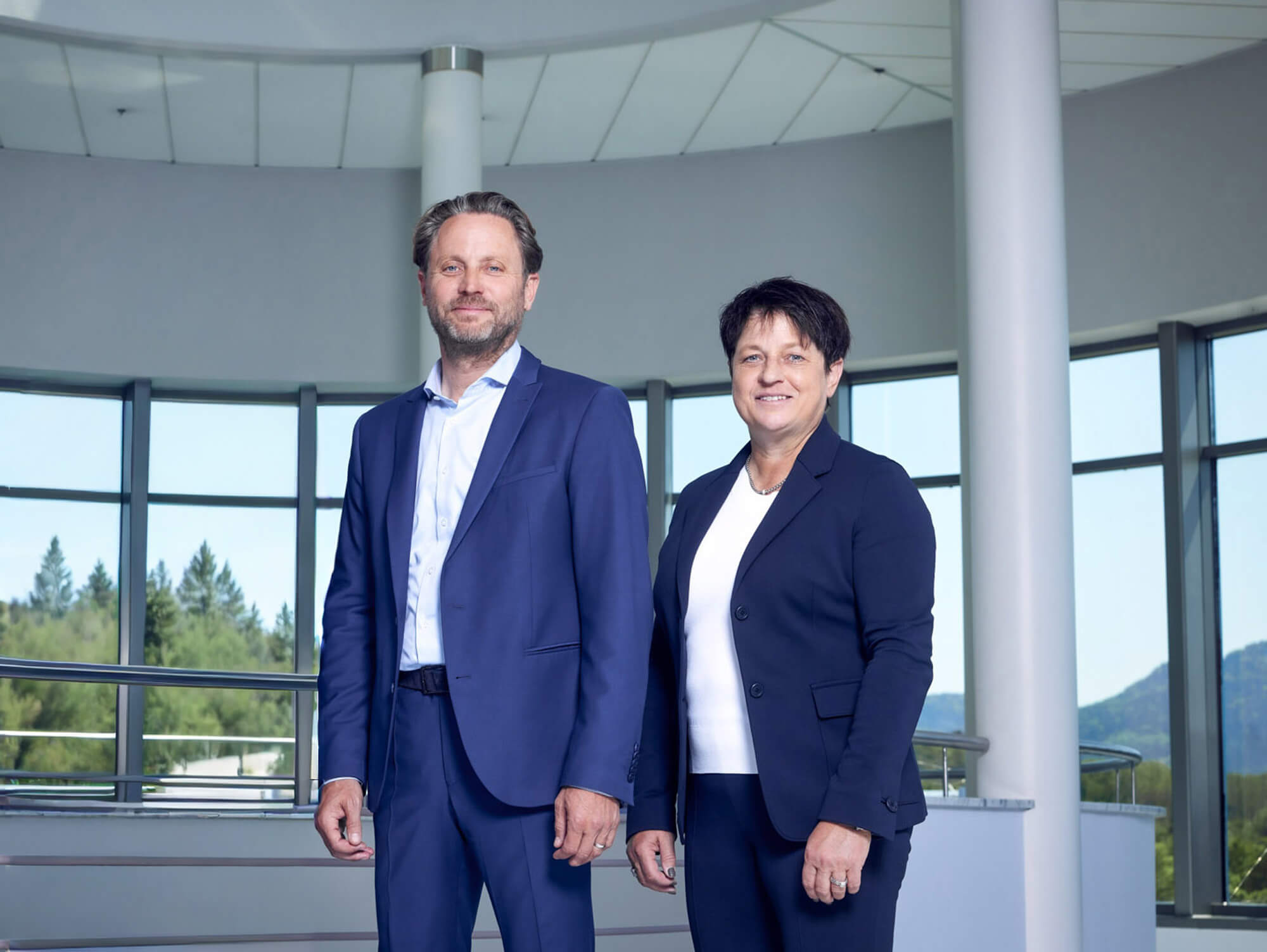
This is, of course, a very special moment for us—another milestone in Bizerba’s long history. Personally, it is wonderful that my sister and I are now the fifth generation involved in this company. We are very proud to have reached this further milestone of “160 years of Bizerba.”
Angela Kraut | Our roots give us stability. Company values such as quality, reliability and responsibility are timeless. They help us explore new paths and boldly shape the future. This is challenging, as developments are rapid and diverse, especially in areas such as digitalisation and AI. Our roots and values help us meet these challenges successfully.
Andreas W. Kraut | On one hand, we uphold traditions and values such as reliability and responsibility, which have guided us for 160 years in our relationships with both customers and employees. On the other hand, we are known for innovation—one of the reasons for our longevity. This interplay of tradition and innovation drives us forward and, in a way, is the secret of Bizerba’s success—whether historically in hardware or, increasingly now, in software. We have always been, and continue to be, at the forefront of technology.
We play a very active role. Naturally, we see Bizerba as a family business in the hands of the Kraut family, but the Bizerba family also includes all employees. We invite them to embrace the Bizerba spirit and get involved. Being a family business also means critically assessing things. The goal must be for everyone to contribute to securing Bizerba’s future. We provide reliability, belonging, and security, but in return, we also expect a willingness to perform. Employees should act as if they were responsible for their own company. We want the members of the Bizerba family to act on their own initiative.
Part of our history and our recipe for success is that we have been a driving force for innovation for 160 years. You can only achieve this if you constantly develop, adapt and embrace change. This ability is what drives us. Standing still was never an option—and it still is not today. Part of our continued development is that we now have several business pillars and are broadly positioned. In addition to store scales and the pure retail business, which is where we come from, we have invested heavily in industrial weighing technology and are growing steadily in this area. This gives us stability across our entire product portfolio, which was also a conscious, strategic approach. We are not dependent on a single product or industry, but have spread our risk across multiple products and industries.
The fact that we have been around for so long shows that our decisions have a long-term impact. We are not driven by quarterly results like a public corporation, for example, but think in different cycles, more in terms of decades. We work closely with customers and partners to experiment together. Many innovations take time to implement, but will have an impact in the medium or long term. Of course, short-term success is necessary, but it is the long-term projects that truly strengthen us. We pursue these projects consistently and implement them when the market is ready.
Angela Kraut | For me, responsibility means being economically successful while acting in an environmentally and socially conscious manner. Reconciling these goals is crucial, and for us, it is part of our identity. Sometimes compromises are necessary, but it is important to find solutions that work for everyone.
Andreas W. Kraut | Responsibility is one of our most important values, one that we have lived by from the very beginning. We take responsibility for our company, our employees, and our customers, and we are happy to do so. People often ask why we handle so many tasks ourselves. It is precisely because we want to be personally accountable for our company, right down to the day-to-day operations. This accountability is important to us and we find joy in it. We take pride in our work and expect the same from our employees.
Additionally, we recognise our social responsibility. Our company name, Bizerba, not only reflects the surname of our founder, Andreas Bizer, but also incorporates the first letters of our town’s name, Balingen. This connection to our region is significant to us and we are committed to it. We actively participate in local community life and support social institutions. It is our mission to get involved and help shape society and politics.
As part of our 2030 corporate strategy, we are committed to investing in our employees. This includes clearly communicating our values and guidelines across all countries and positions within the company. By doing this, we are establishing a binding framework for our actions. Our goal is for all teams—whether in Germany, Mexico, or China—to embody these values in their daily work, benefiting both the company and our partners and customers. Our customers expect Bizerba quality, regardless of where they purchase our products.
Cultural identity is particularly strong in Germany and we continue to expand into new countries that require development. However, the foundational values and guidelines apply to our approximately 4,500 employees worldwide. We recognise that market conditions vary by country, and we take into account the differing customer needs in places like South Africa and Germany.
By delivering what we promise. Quality is a valuable asset and an essential requirement. Transparency and a customer-centric approach are also vital, as they form the foundation for building and reinforcing trust in the Bizerba brand. Furthermore, we invest in innovations that provide real value to our customers. Our goal is to stay ahead of the competition by introducing good ideas and new technologies, such as the modern Supersmart checkout solution in the retail sector.
To achieve genuine innovation, you have to lay the groundwork. We view innovation as a blend of technical possibilities and ideas generated by our employees and partners. This requires openness and transparency in our interactions. Additionally, it also requires a healthy culture of error. You need the freedom to try new things and the opportunity to be creative to unlock potential. And if one approach doesn’t work, you try another.
Moreover, openness entails embracing new technologies and forming new partnerships. Innovation cannot thrive in isolation; there are too many interdependencies and opportunities to overlook. You must assess what you can accomplish on your own and where you need to involve others so that a solution can grow.
Consider our original product, the scale, as an example. In the past, they displayed the weight; today, they are sophisticated, connected multimedia devices. Cameras, object recognition and comprehensive software solutions for process optimisation are integral parts of this technology. The act of weighing is just one element in a more complex system. Behind such a product lies an extensive internal and external network that must be continually developed and maintained.
To me, leadership means providing guidance, placing trust in others and enabling their development. It is important to listen, consider their ideas and encourage them to take initiative, as many great ideas often come from within our own ranks. Additionally, it is important that everyone feels seen and valued—in my view, this is becoming increasingly important. This includes expressing recognition and making appreciation visible.
This brings us back to the topic of innovative strength, which stems from close, collaborative business relationships. After all, valuable ideas also come from partners, suppliers and customers. We cannot solely rely on our knowledge to find the best solutions and improve our processes; we need feedback to guide us. Here, too, meeting on equal terms is the recipe for success.
This is a very important issue, because we see sustainability as a driving force for innovation. Energy-efficient products and digital solutions are both ecologically sound and economically attractive. In the best-case scenario, economic success results from sustainable practices. For example, we have developed a cutting machine with a motor that adjusts based on the type of product being sliced. When slicing soft cheese, the motor runs slower, while it runs faster for harder salami. This approach not only reduces electricity consumption but also saves our customers money. The future must see ecology and economy working hand in hand.
Our focus right now is on geostrategic alignment. We are closely monitoring economic and political developments worldwide, particularly in Europe, the US, and Asia, and tracking their foreseeable effects. We have to decide what we want to do with whom in which countries. Given how dynamic these developments are, this is one of the biggest challenges we currently face. It is also important not to become dependent on individual suppliers—keyword: semiconductors. We protect ourselves against this with a multi-supplier strategy, in which economic factors must, of course, always be taken into account. Although we cannot completely eliminate the possibility of bottlenecks, we can significantly reduce that risk.
Openness is the basis for innovative strength. This does not imply that we share everything with the outside world, but cooperation must work within our own ranks. Development must anticipate how new innovations will be implemented in production and how they will be supported in customer service. In other words, every area of the company needs to contribute to the success of an innovation. In other words, all areas of the company must participate in order to make an innovation successful. This doesn’t always work perfectly, but the goal is always to take everything into account. In this not entirely straightforward process, the ability to accept criticism also plays a decisive role. I include myself in this. Constructive and relevant criticism is always welcome.
I would like to travel back to 1924, the year when Bizerba launched its first scale, our first successful product, which made us the market leader at the time. Until then, we were more or less a manageable, small-scale workshop. It was the first so-called quick scale, where you just had to place an item on it and have its weight displayed on the other side. That was the real breakthrough for Bizerba. It would be fascinating for me to know how my colleagues at the time reacted and how this development then took its course. My great-grandfather and my grandfather were there, so it must have been an exciting time.
That is a very important issue. The fact is that investments can typically be monitored using clear key performance indicators, which allows us to align them with the courage to invest in future technologies. And if the anticipated success doesn’t materialise, we can implement countermeasures promptly. Therefore, security and innovation can coexist; however, it’s important to weigh our options and carefully discuss them from time to time. We need innovation to grow, and it should be pursued with both courage and common sense.
I would thank him for his pioneering spirit, which continues to inspire us to this day. His achievements laid the foundation for our entire company. I would be fascinated to learn about the origins of our innovative strength. That’s why I would ask him what motivated him to pursue a career in weighing technology. Did he recognise its potential back then?
Andreas W. Kraut | First and foremost, I would like to thank everyone who has remained loyal to Bizerba, both as employees, partners and customers—some of whom have been with us for generations. There are truly impressive stories of people whose grandfathers worked at Bizerba and of customers who have been using our Bizerba scales for 80 or 100 years.
This is not only a success story for Bizerba, but for everyone who is part of it – and we are very grateful for that. We are also thankful that we were able to shape this company together and continue to do so. Looking to the future, the clear message is that we are committed to advancing the family business, Bizerba. We invite everyone to join us in this endeavor for the next 160 successful years and for many generations to come.
Angela Kraut | My message to our employees is one of great gratitude for their commitment. Without a strong team, success would be unthinkable; they are the heart of our company. I want to thank our partners and customers for their trust and look forward to shaping the future together. My wish for the next generation is that they preserve Bizerba’s values and have the courage to try new things continuously.